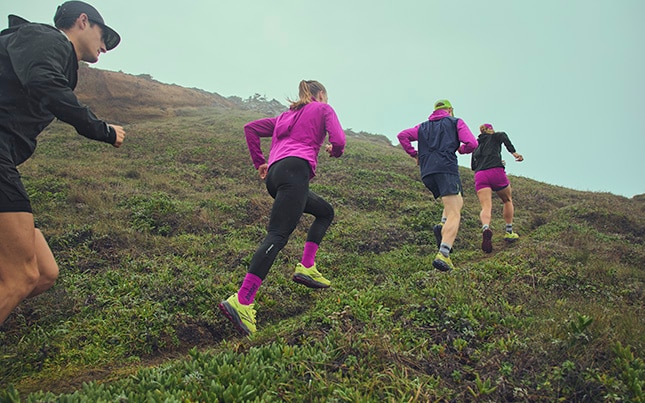
Brooks wants to share with you how we feel barefoot running relates to the Perfect Ride for Every Stride.
>> Note: This document is also available in downloadable PDF form.
>> Read and comment on an Open Letter to the Running Community from Brooks CEO Jim Weber.
RUNNING: THE CONNECTION BETWEEN FOOT AND GROUND
For decades runners have explored the merit of running barefoot and whether it might be a more enjoyable, efficient, and/or safe way to engage in the run. A recent spotlight on the matter gives those with expertise in running an opportunity to educate and inspire a growing population of runners worldwide.
BROOKS’ PERSPECTIVE
Whether to run barefoot is a highly contested topic—possibly the most heavily debated topic in our sport—and we’re enjoying the dialogue because at a base level, people are talking about a major positive force in the world: RUNNING.
That said, we strongly believe the vast majority of the running population should log most of its mileage in a performance running shoe, not barefoot.
Bear in mind, we recognize a very small percentage of runners may find running barefoot valuable as part of a controlled training regimen. But for the rest of us, supportive, cushioned footwear is not only beneficial, it also plays an essential role in delivering a comfortable, injury-free running experience.
WHAT FOLLOWS
As a leading running company, we feel it is our obligation to offer an in-depth examination of shod vs. unshod running to address existing curiosities and confusion about these options. Following is a robust discussion from our Brooks footwear team on this topic, accompanied by qualitative analysis from respected experts in the field.
DIFFERENT FOLKS, DIFFERENT STROKES
Joint center. Calcaneus bone. Navicular drop. These are all phrases used often in normal hallway chatter at Brooks. We know feet. We know biomechanics. We know runners… and we know their needs better than anyone out there. We also know people are actively exploring whether barefoot running might be beneficial for them. Our main goal and responsibility is to keep people running and injury-free, so we want to educate runners so they can make an informed decision on this topic.
I think it’s great that people are talking about running shoes and the biomechanics of our sport. Our emphasis at Brooks has been finding the Perfect Ride for Every Stride. That means looking at runners’ individual foot shape, gait, and pace, and building a solution that works in harmony with their biomechanics to get them as close to natural running form as possible without risking injury. The best shoe is the one that works best for you.
-Pete Humphrey, Vice President of Footwear Research and Development at Brooks
Runners are about as unique as their own thumbprints. Some are slight in build with a gazelle-like stride and efficiency. Others are of much larger stature with collapsed arches and a heavy foot strike. Some run 100+ miles a week on trails, while others run around the block with their dog. While all are runners, their biomechanical needs—and hence product needs—are all unique. Before deciding whether barefoot running is best, it’s important to first examine how you run, finding the right shoe (if needed) that addresses your unique biomechanical needs, and setting a training program that best suits you to keep you injury-free mile after mile. The Perfect Ride for Every Stride, as we say at Brooks.
Whether the discussion is about barefoot running or optimal foot strike, the true essence of this ongoing running dialogue centers on four big questions:
Let's examine these questions now...
Some say to run, just put one foot in front of the other at a speed faster than walking. While this is technically true, how you run can greatly affect your comfort and performance. Many who choose to run barefoot do so because they believe it is the best way to achieve natural running form, and to leverage the intended, birth-given anatomical functions of the human foot. At Brooks, we are also strong believers in the principles of natural motion, which we call “optimal” running. We define optimal running as running that decreases forces across joints, moments, and work done by the muscles— this makes us more efficient and allows us to experience a decreased internal stress load. By moving acting forces closer to the joint center, we can decrease the lever arm and resulting moments.
Running the way our bodies intended will provide the greatest efficiency and may ultimately decrease the incidence and severity of several key running injuries. Unfortunately, due to foot deformities, uneven or sharp running surfaces, previous injuries, or a myriad other reasons, the vast majority of runners cannot achieve optimal running form without the help of performance footwear.
We use the human body and foot as our baseline to engineer Brooks footwear. We work diligently in the lab conducting research on runners to best understand their biomechanics. We make our shoes mimic the natural motion of running, while still protecting feet from outside elements, cold, rocks, dirt, and pavement.
- Eric Rohr, Biomechanical Engineer at Brooks
The search for the Holy Grail of optimal running is nothing new to Brooks. In 1995, we launched our first Podular™ shoes with a simple concept in mind: create a midsole and outsole system that would allow each shoe to work in harmony with the natural motion of the foot while providing the comfort, support, and protection from the road the foot needs. From there Brooks implemented the Podular™ system across our product line, and we’ve been working on how to further improve the shoe-to-foot interface ever since.
Through extensive research we’ve also discovered that through natural motion engineering and design, we are better able to achieve the goal of moving forces closer to joint center in the running gait, or natural/ optimal motion form. We continue to engineer this knowledge into our Brooks footwear line by taking into account how these principles are applied to each foot type and across our range of products. Our goal is for our shoes to work in concert with the healthy natural motion of the foot.
So what should be considered when assessing how you run? Following are just a few of the factors Brooks examines when assessing a runner’s gait: high range of mobility. Some runners are midfoot or forefoot strikers, while others strike at the heel. Within these segments:
- Are you a midfoot striker, forefoot striker, or heel striker?
- What forces and motions do your knees, ankles, hips, and other joints experience?
- Are you new to running or have you been running for years?
- What injuries, if any, have you had?
- What distances are you planning to run?
- How often do you run?
- What is your stride length?
- What is your running cadence, or strides per minute?
- On what surfaces do you typically run?
This information varies greatly from one runner to the next and, as you might imagine, affects the way each person runs and the forces he or she places on the foot and body.
Q: What's the right show for me?
Brooks’ believes that the best shoe for each runner is one that works with the individual and his or her unique biomechanics.
The human body is smart, adaptable, and exclusive to every individual. The foot alone has 26 bones, 33 joints, and hundreds of muscles, ligaments, and tendons that must all work in harmony to allow us to stand, to walk, to jump, to run. Our feet function as a propulsion mechanism, provide natural shock absorption during movement, and are the first sensor our bodies react to when they hit the ground. At Brooks, we believe our running shoes should harmonize with these natural functions of the foot.
In order to design and build shoes that accomplish this, we use the human body and foot as our baseline to engineer our footwear. Over the years Brooks has recognized there are different body types, foot types, and even more variations in how the runner runs. Some runners have high-arched rigid feet, while others have a low arch with a high range of mobility. Some runners are midfoot or forefoot strikers, while others strike at the heel. Within these segments, some people overpronators, while others have a neutral gait. We embrace these differences in each runner and strive to build the best product for each and every runner. To give you a simplified glimpse into how we develop our product line, following are basic biomechanical filters we use when creating Brooks’ footwear architecture:
Foot Type: We first start by assessing key anatomical aspects of the runner and his/her feet, including range of motion and navicular drop. Three main classifications of foot type come out of this assessment: A hypomobile foot type is one that is rigid with limited natural pronation. A neutral foot type has moderate range of mobility and a natural ability to move and absorb, with zero to slight overpronation. A hypermobile foot type is a more flexible foot that tends to overpronate.
Fit: Another factor that must be considered is the width of a person’s foot. Many Brooks shoes are created in widths to accommodate a broader foot. Brooks also incorporates flexible materials and designs—such as met head windows, pliable yet supportive meshes and overlays, contoured sockliners, etc.—intended to wrap the foot so that the shoe feels like an extension of the body. The last of a shoe also factors into the fit equation. Proper fit is essential to reducing the incidence of hot spots, blisters, overall discomfort, and injury.
How you run: Once we’ve established a basic foot type and fit, we then look at how each runner runs. This includes gait strike, running frequency, speed, experience, cadence, and so much more. As addressed earlier in the section “How do I run?” every runner runs differently. One style isn’t necessarily good or bad, but each is a unique situation requiring a unique approach in terms of gear solutions.
Once we finish this three-pronged assessment, it is then time to build a shoe that meets your unique biomechanics and natural running motion. Through years of internal and external research, Brooks has developed an optimal pressure and motion path based on natural running motion research for each foot type that we believe allows the runner to run more efficiently, reduce the risk of injury, and allow for a more enjoyable run.
The chart below illustrates the process Brooks’ footwear design and development teams take when developing shoes for various foot types. The real process is not this simple—there are many other factors to consider. But for illustrative purposes, these graphics demonstrate how we would design and build the right shoe for you, getting you as close as possible to your optimal running form.

First, Brooks looks at what type of foot a runner has:
Hypomobile:
High Arch, Rigid Foot
Neutral:
Medium Arch,
Moderate Range of Mobility
Hypermobile:
Low Arch,
High Range of Mobility

Then, Brooks considers a runner’s gait by looking at these factors:
Running Gait:
Heel, Midfoot, or Forefoot Strike;
Range of Motion;
Speed of Motion
Running Gait:
Heel, Midfoot, or Forefoot Strike;
Range of Motion;
Speed of Motion
Running Gait:
Heel, Midfoot, or Forefoot Strike;
Range of Motion;
Speed of Motion

Third, Brooks uses biomechanical research to assess the optimal pressure and motion path of each foot type and uses this data as a tool for developing its footwear to allow for more natural motion to occur:


Last, Brooks builds and designs shoes for each specific foot type and running gait that mimic the optimal pressure and motion path as closely as possible with out affecting performance:
» Defyance
» Glycerin®
» Ghost
» Summon
» Ghost
» Launch
» T6
» Green Silence
» Trance™
» Adrenaline™ GTS
» Adrenaline™ ASR™
» Ravenna
» Cascadia
» Racer ST
» Beast®/
Ariel®
» Addiction™
» Dyad
As variables to foot type, fit, and how you run change, the right shoe for you may also change. For example, you might choose a shoe with more support for longer training runs—during which your joints, muscles, and ligaments will fatigue—while you conduct shorter workouts or race in a more minimalist shoe. Whatever the case, we strongly recommend each runner consult an expert—specialty running store clerk, coach, trainer, podiatrist—who can watch you run and help you determine the best shoe(s) for you.
It’s important to understand the significance proper training plays not only in performance, but also in injury prevention and recovery. In fact, research suggests that running injuries could be cut by roughly 25% (“Sport for All: Sport Injuries and Their Prevention,” Council of Europe, Netherlands Institute of Sports Health Care, Oosterbeek, 1989) if runners made adjustments in their training schedules and routinely strengthened their muscles and joints.
One of the key mistakes runners make is that of overuse. Runners tend to pride themselves on how many consecutive days they’ve run and how many miles they logged. While pushing the limits may work very well for some, it can lead to injuries for others. For example, the new runner does not have the intrinsic strength of the more experienced runner. Quickly adding miles and consecutive running days without adequate recovery time can be a recipe for disaster for these runners. Even more experienced runners need to be careful adding miles to their regime without adequate rest. In fact, studies also show that the highest running injury rates occur in individuals who notch more than 40 miles per week. Increased mileage means more repetitive stress on the areas in your body that are most prone to injury. And since we know 56% of runners choose to run on unforgiving roads, this is a risk runners should take seriously.
To maximize your run, we recommend you meet with a coach, join a training group at your local running specialty store, or research an online program that will help you build a training program that is right for you and your running goals. Increase your mileage slowly and give yourself time for proper recovery.
Q: How do I remain injury-free?
At Brooks, injury prevention is of paramount importance when we design footwear. We’re committed to continual work with the top researchers in the field to keep runners healthy. Every day we learn through science, engineering, proper training, education, and runner feedback, and we apply such findings toward design and development.
We at Brooks believe that the shoe plays an important part in helping the runner experience the perfect run. Our ultimate goal and—greatest satisfaction are achieved when runners tell us how much they love our shoes. We work very hard to engineer the best possible running footwear for each individual. Every runner is different though, so it’s a tough job! The human body—more specifically, the foot—and the natural motion of running serve as our guiding principles for footwear creation. Our promise to the runner is that we’ll tirelessly work on perfecting our shoes to deliver amazing running experiences that keep people running injury-free.
- Andre Kriwet, Director of Footwear Merchandising at Brooks
Currently, there is no conclusive evidence demonstrating barefoot/minimalist running reduces injury or that running in running shoes causes injury in every runner. We can only say that runners continue to get injured, and that we have been and will continue to conduct prospective and retrospective research in this area that will enable us to build the best products to keep people running healthy.
David M. Brody, in his work “Running Injuries: Prevention and Management (Clinical Symposia)” published in 1987, states, “Up to 70% of [runners] will at some time sustain a running-related injury.” He goes on to say, “The injuries are usually the result of faulty training techniques, biomechanical abnormalities, congenital or acquired conditions, or a combination of these factors.” We believe a combination of the right shoe for you, a solid training program, proper strength training, and a focus on improving running form can reduce the risk and frequency of these injuries.
Before we go further into injury prevention— how our shoes help reduce the risk and what else can be done to prevent injuries—let’s first look at the top running related injuries and the frequency with which they occur:
| Frequency of Running Injuries | Top 5 Injuries That Occur in Runners | ||
|---|---|---|---|
| Knee | 42.1% | Patella Femoral Pain Syndrome IT Band Injuries |
16.5% 8.4% |
| Foot/Ankle | 16.9% | Plantar Fasciitis | 7.9% |
| Lower Leg | 12.8% | Shin Splints Tibial Stress Fractures |
4.9% 3.3% |
| Hip/Pelvis | 10.9% | ||
| Achillies/Calf | 6.4% | ||
| Upper Leg | 5.2% | ||
| Low Back | 3.4% | ||
As you can see from the data above, knee injuries are the No. 1 affliction for runners. According to J E Taunton’s study, “A retrospective case-control analysis of 2002 running injuries,” knee injuries have hovered around the 42% mark over the last 25 years, but the percentage of those runners with Patella Femoral Pain Syndrome (PFPS) has decreased. The table below details these findings.
| Year | Percent of Runners with Knee Injuries |
Percent of Runners with Knee Injuries Who Had PFPS |
|---|---|---|
| 1980 | 42% | 60% |
| 1984 | 44% | 50% |
| 2002 | 42.1% | 46% |
While the reasons, percentages, and means for prevention remain debatable, the fact that runners are still getting injured is not. It’s important, however, when comparing running injury rates over time, to consider how the running population has changed. Running USA’s 2008 State of the Sport report states that the total number of finishers of U.S. road races rose from approximately 3.8 million to 8.9 million from 1987 to 2007, an increase of 134%. With the increase of road race finishers also comes a rise in marathon finish times. For example, median marathon finish times for men are shown to have increased from 3:32 in 1980 to 4:16 in 2008. What do these stats tell us? Over the years, we’ve seen many novice runners join the sport, pushing up marathon times and injury rates. Many of these new runners do not understand how to properly train, may be wearing shoes that aren’t right for their foot and/or gait, and/or have underlying health conditions that make them more injury prone.
As stated above, we believe footwear is a major factor in preventing injuries. In the last few years, we have dramatically increased our investment in our own internal biomechanics lab, as well as in external university-level research with partners. Creating footwear that allows runners to run in harmony with their unique biomechanics and natural running motion will help them run more efficiently, and decrease the risk of injury by moving forces closer to joint center and reducing resulting moments. This may diminish the incidence and severity of several key running injuries, specifically PFPS in the knee. Through our internal lab and research partners, we have and will continue to conduct studies that will enable us to target specific injuries and engineer footwear that will reduce the factors that cause these injuries. To date, we’ve created footwear that has reduced internal knee rotation by 11.73%, internal ankle rotation by 7.21%, and ankle dorsiflexion by 4.65%.
The majority of running injuries are actually recurrences of previous problems because our body structure becomes weakened by past injuries. What does this mean? For the most part, it means that we’re not learning from our mistakes. We’re not doing a good job of strengthening, stretching, and developing our problem areas, and altering our training to keep us running healthy. We often take pain reducers, rest, and ice as quick fixes to get us up and running as quickly as possible. These are simply short-term solutions. Instead, we need to strengthen and lengthen muscles and tendons to stabilize our joints so they will hold up under the stresses and fatigue of future training. Of course, there are also major injuries that need ongoing care from a doctor in order to find a long-term cure. If we listen to the warnings our bodies give us, and work on strengthening and developing these weak areas, the chances of these injuries occurring and reoccurring will be greatly reduced.
SO ARE YOU STILL WONDERING WHETHER YOU SHOULD RUN BAREFOOT?
For the large majority of us, we would not recommend it. For many, barefoot running introduces more new injury risk factors than the number it eliminates. But as you may have guessed already, we do believe that unshod running has a place and purpose for some runners.
Some of the positives behind unshod and shod running are not necessarily apparent. Barefoot running allows runners to get in touch with their body by providing greater proprioception. Furthermore, it can help develop a more efficient gait if the runner is coached and trained properly. In addition to obvious protection from hard surfaces and sharp foreign objects, shod running enhances the natural shock absorption capacity of the body, and can improve foot and gait problems (unhealthy motion) that many runners have.
As stated previously, strength training plays a major role in injury prevention and treatment. Barefoot running, if implemented properly, can be used as an effective supplemental tool in a training program to increase the strength in your feet. It allows the foot to move naturally and can help strengthen the weaker muscles, tendons, and joints along the kinetic chain needed for running. We do caution that if you decide barefoot running is right for you, be sure to build up your mileage slowly when implementing it into your training program. Also take into consideration the surfaces on which you’re running and listen to your body. Too much too soon will result in injury, especially for those who haven’t yet developed adequate strength in their running muscles.
We recognize there’s still much to learn in this area, and we will continue to conduct clinical tests, as well as retrospective and prospective studies, on unshod and shod running with our research partners to further our knowledge.
IN SUMMARY
At Brooks we view the run as the best part of the day. We are obsessed with it. Our main goal and responsibility is to keep people running and injury-free. We believe the perfect shoe for each runner depends on gait, fitness level, training program, injuries, and much more. We also believe in a combination of the best of both worlds. Within a comprehensive training program, there is a place for both a high-mileage performance running shoe and more minimalist footwear (a more practical way to retain the feeling of running barefoot, while protecting the foot). In rare, controlled cases, there may even be a place for no footwear at all. The perfect solution for each runner depends on his or her unique needs. The right training combined with the right footwear is critical to allowing each individual to run farther, faster, longer, healthier, and happier.


That said, we strongly believe the vast majority of the running population should log most of its mileage in a performance running shoe, not barefoot.