
 Argentina
 Brazil
 Canada
 Chile
Chile
 Colombia
 Ecuador
 Mexico
 Peru
Peru
 United States
 Israel
 South Africa
 Österreich (Austria)
 Belgique (Belgium)
 Croatia
 Danmark (Denmark)
 Deutschland (Germany)
 España (Spain)
 France
 Greece
 Ireland
 Italia (Italy)
 Luxembourg
 Nederland (Netherlands)
 Norge (Norway)
 Polska (Poland)
 Slovenia
 Suisse (Switzerland)
 Suomi (Finland)
 Sverige (Sweden)
 Türkiye
 United Kingdom
 Australia
 中国 (China)
 Hong Kong SAR
 India
India
 日本 (Japan)
 Malaysia
 New Zealand
 Philippines
 Singapore
 대한민국 (South Korea)
 ประเทศไทย (Thailand)
 Vietnam
Tips for proper running form

One of the most natural and accessible forms of exercise is running, and it’s something that should come easy to many of us.
After all, it’s one of the first skills we learn! However, you might not realize that it’s a subconscious activity requires some conscious thought.
While your shoes are arguably a very important aspect of your gear – we know the right running shoes can affect everything from speed to injuries – you should also be thinking carefully about your running form. The right running form could be the difference between running confidently to get those PBs and injuring yourself while on the go.
"Good running form isn’t about looking perfect, it’s about moving efficiently for you. Most runners get more economical simply by running more. Trust your body to find its rhythm, and avoid overthinking or forcing changes too early." - Steve Cardy, eCommerce Merchandising Manager
Our tips will show you what proper running form looks like, and how you can ensure you’re keeping good posture throughout your run.
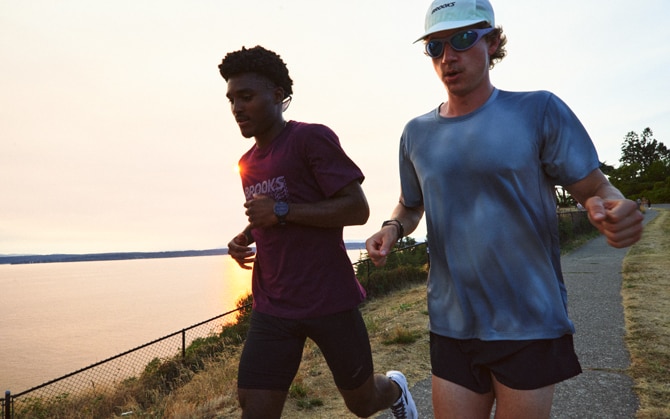
What is good running form?
To put it simply, good running form is the safest and most efficient way you can run. Your form should allow you to move quickly and comfortably, without suffering from irregular pain or strain on your body.
Essentially, having good running form means that:
- Your feet are directly below the center of mass (in other words, your body)
- You maintain an upright posture with a straight spine
- You avoid moving from side-to-side
This combination of good running form can not only impact performance, but allows you to all the health benefits of running.
Going into even more detail, some of the key factors that influence good running form include:
- Posture: your shoulders should be relaxed while you hold a tall stance and lean slightly forward from your ankles. Your back should be kept straight, and you should keep your core engaged.
- Foot strike: this is something that varies from person to person. However, you should typically aim for a mid-foot strike to a soft landing before rolling through the stride.
- Arm swing: proper arm swinging technique involves keeping your elbows folded at 90° with a relaxed swing at the waist. You should avoid crossing your hands in front of your body.
- Alignment: your hips, knees and ankles should be aligned during the entirety of the run.
- Head position: keep your head looking up and straight ahead, avoiding letting it drop down to look at the floor.
How to improve running form
By staying aware of how your body moves, and making focused adjustments, you can improve your running form. Even though running is a very natural movement, proper running requires conscious thinking. Here are a few mindful changes you can make to improve your running form.
Proper running posture and alignment
Proper running posture requires maintaining a tall stance, with your head held straight and aligned with your body. You should avoid any slouching, while could lead to neck and shoulder aches.
Lean slightly forward from your ankles to give you the forward momentum to run, and to reduce any strain on your back. Throughout your run, remember to keep your shoulders and arms relaxed. This means avoid clenching your fists or tensing your shoulder when you start to feel fatigued.
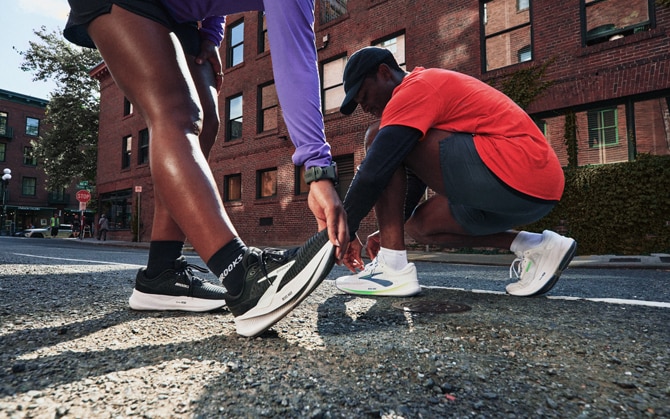
Foot strike while running
Proper foot strike techniques involve landing mid-foot to evenly distribute the impact, which reduces the strain on your shins and knees. You should also avoid overstride, which is where you extend your stride too far in front of you. Instead, aim and landing beneath your body to maximise your running efficiency and reduce any injuries.
Build good running cadence
Your running cadence is the number of steps you take per minute. It’s also commonly known as your stride frequency or your step rate. The optimal and ideal running cadence differs from person to person, and depends on factors such as your natural speed and your stride length.
Maintaining a good cadence while running can help you reduce any overstride and fatigue, and can keep you moving at a steady pace. You can find and maintain a steady rhythm by using a runners app, such as RunTempo or Cadence.
Consult a professional runner
This one may be a little trickier, as it involves taking more time out of your day. However, consulting with a professional running coach can do wonders for your run time and technique. Professional running coaches can conduct a gait analysis, which provides insight into how you run, whether you overpronate or supinate. This gives you deeper insight into what running shoes are best suited for you.
If you don’t have the time to see a professional, you can take our online Shoe Finder quiz to conduct your own gait analysis.
A professional run coach can also give you tailored advice on how to fix your running form and posture.
Invest in a good pair of running shoes
We’ve previously discussed the importance of a good pair of running shoes, and for good reason. Your shoes can make a huge difference to the way you run. Depending on your gait analysis, you can choose the right type of shoes based on your individual needs.
For example, you may suffer from overpronation and need specific running shoes with the right kind of arch support. Or, you might need supination running shoes if you’re underpronating when you run. These shoes work by keeping your weight from shifting too far on either side.
Look for shoes that provide arch support and a heel counter, while being comfortable for your feet.
Exercises for better running
If you’re looking to improve on your running skills, you’ll need to focus on other exercises, such as strength training, to supplement your runs. By working on your full body, such as upper and lower body strength and core workouts, you’ll be able to see a noticeable difference in the way you run.
Having a strong core means that you’ll be able to keep it engaged during your runs, helping your posture. By working out your upper body, your shoulders and back can stay strong during your runs, reducing any slouching during times of fatigue. And, of course, by working out your lower body muscles, you’ll be able to run faster and further.
Resistance training can also help improve your endurance and stamina, keeping you running further for longer.
Some exercises you could incorporate into your training include squats, weighted lunges, dead bugs, and Arnold press.

Can bad running posture cause shin splints?
Yes – poor posture while running cause be a cause of shin splints, especially if you’re prone to overstriding or landing heavily on your heels. Overstriding can put unnecessarily extensive pressure on your tibia and hip muscles, while landing on your heels excessively directly impacts your shins.
If you’re prone to overpronation, you could be at a higher risk to suffering from shin splints. You can reduce the chances of experiencing shin splints by fixing your running posture, investing in the right running shoe for you and working on your lower body muscles.
Improving your running form over time
Like any skill, practice makes perfect. And the same is true for running. While it can be an easy habit to pick up and continue, running well with a good posture can be difficult if you’re not thinking carefully about it. And if you’re running with bad form, you run the risk of breaking any streaks and not beating your PBs.
If you’re serious about running, you should run often and with purpose. Think carefully about if you’re tensing up and where you may be holding that tension. Prioritise other workouts, such as core and resistance training, and incorporate running drills to help with your stamina and endurance.
It’s easy to get started and keep on running, and with consistent training, you’ll be able to see marked changes and successful runs.