
 Argentina
 Brazil
 Canada
 Chile
Chile
 Colombia
 Ecuador
 Mexico
 Peru
Peru
 United States
 Israel
 South Africa
 United Arab Emirates
 Österreich (Austria)
 Belgique (Belgium)
 Croatia
 Danmark (Denmark)
 Deutschland (Germany)
 España (Spain)
 France
 Greece
 Ireland
 Italia (Italy)
 Luxembourg
 Nederland (Netherlands)
 Norge (Norway)
 Polska (Poland)
 Slovenia
 Suisse (Switzerland)
 Suomi (Finland)
 Sverige (Sweden)
 Türkiye
 United Kingdom
 Australia
 中国 (China)
 Hong Kong SAR
 India
India
 日本 (Japan)
 Malaysia
 New Zealand
 Philippines
 Singapore
 대한민국 (South Korea)
 ประเทศไทย (Thailand)
 Vietnam
Race advice: Rome Half Marathon

You’ve done the hard work and put the training in, and it’s nearly time to line up for the Wizz Air Rome Half Marathon by Brooks.
But there’s always time for a little last minute advice from people in the know. We invited runners from our community to share their top tips on the Rome half marathon. From the key race strategies to the all-important spots for carb loading, here’s their advice for making sure race day goes smoothly. We’re happy to introduce the runners to you:

1. Don’t get caught out by the weather
Rome in October means anything can happen when it comes to the weather – it could either be scorching or cool and it can be easy to get caught out.
Isabella Novati advises: “the start in the morning will probably be fairly cool, with temperatures rising over the course of the day”, and Massi Milani agrees, suggesting that “the usual suspect is heat, not cold or rain, and the course gives you almost no shade. So dress for 5°C warmer than what you feel in the corral: singlet, shorts, a cap, and drink early.”
If it’s cooler in the morning, Mattia Marazzoli suggests warming up in layers: “Typical conditions for a half marathon in October are between 8-15°C, so ideal temperatures for starting the warm-up in heavier clothing, then getting ready in your race kit 10-15 minutes before the start.”
It’s a good idea to bring a throwaway layer or one that packs down into a pocket or waist belt so you can take it off before you begin.
2. Stick to your assigned corral
There are corrals at the Rome half marathon, and they get busy.
Massi says: “Last year there were 22,304 registered runners, and with those numbers the pens fill unevenly and people drift into the wrong one.”
That’s why it’s so important to go to your assigned corral rather than trying to jump into a faster one. Isabella says: “It's important to respect your own assignment to avoid overlapping with other runners and to let everyone have an enjoyable race that isn't too crowded. Nobody likes getting "stepped on" or having to start out walking because there are too many people.”
3. Plan for a warm up
The start and finish of the half marathon are in two different places, with the race starting on Viale di Porta Ardeatina and finishing in front of the Colosseum on Via degli Annibaldi. Your bag will be collected at the start and will be waiting at the finish for you.
But you do need to walk from the bag drop-off point to the start line. Massi suggests that this is a great opportunity for a warm up: “Budget about 1 km from the trucks to the start line, so drop your bag well before you'd like to, not at the last minute. That extra kilometre is also your warm-up, so plan the timing backwards from your wave.”
4. Don’t trust the GPS
Rome is a big, busy city – and all of our influencers agree that means GPS isn’t always accurate. As Massi explains: “The course spends a lot of time in narrow streets with tall buildings on both sides, like Via del Corso, Piazza Navona and Largo Argentina, and the signal bounces off the walls.”
Mattia suggests a tactic for this, saying:
“I find the right strategy is to set the main screen to show pace per km, to get a rough idea of the pace you're running at, while always treating the "laps" between the km markers placed by the race organisers as the true measure.”
5. Don’t start too fast
It can be tempting in any race to set off at a rapid pace. Your legs are feeling good after the taper, and you’re caught up in the atmosphere and the pace of the people around you. But all of our influencers agree that it’s a bad idea. Isabella warns: “Don’t start too fast, or you’ll pay for it later.”
Mattia recommends trying to run a negative split for the race, or trying this tactic: “Up until the 10 km mark, the run should feel almost "too easy," so that you can pick it up in the second half of the race.”
Massi also has some sound advice for making sure you don’t go out too fast: “Run the first 5 km around 5 to 10 seconds per kilometre slower than goal pace and treat that as deliberate, not as lost time. Settle to goal pace by km 10, and spend whatever is left over the last four kilometres down to the Colosseum.”
6. Be prepared for hills…
Rome is a hilly city. As Massi puts it: “Don’t let anyone tell you this is a pancake”. The undulating nature of the course means that you may find it harder than a flat half marathon.
He explains his strategy: “Last year there was a proper climb at around km 7, short but steep enough to break your rhythm just as you'd settled into pace. Keep the effort constant, let the pace drop, and take it back on the descent. The rest is small rises and dips through the centre, plus a lot of turns, several of them tight. Expect the last 5 km to feel harder than your watch says.”
7. …And cobblestones
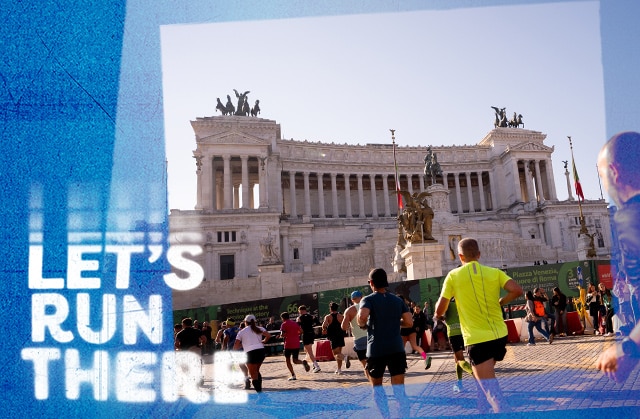
As well as being hilly, Rome is also a cobbled city – and that can be difficult underfoot if you’re not used to it. Isabella says:
“Rome is characterized by narrower streets and a few ups and downs, but above all by the sampietrini (cobblestones). Compared to asphalt, they can be uneven and not always the most comfortable running surface.”
Mattia suggests that if you haven’t already chosen your race day shoe, you may want to take the cobblestones into account: “Think about shoes more than for a normal half. There's real cobblestone and a lot of turning, so a tall, soft, plated shoe can feel unstable where you need precision. Don't debut your supershoes here.”
In general though, while it’s worth being aware of the cobblestones, they’re nothing to get overly worried about. As Isabella puts it: “The beauty of the city makes you forget all about it.”
8. Don’t forget to look up
While you want to lock in and race to the best of your ability, you’ve also come all the way to Rome to experience running in this amazing, historic city – so don’t forget to look up and appreciate the landscape you’re running through.
Isabella says: “Every meter of the race will offer beautiful glimpses of the city. The historic centre is full of churches, palaces, corners, and monuments — all spectacular. There's certainly no chance of getting bored, and that will help take your mind off the fatigue of the race. For those without overly ambitious time goals: take it as a beautiful sightseeing tour of the city.”
Massi agrees that it’s always a good idea to look at the sights. He walks us through the main sights: “This is the rare race where looking around is worth a few seconds:
- You start at Circo Massimo with the Palatine on your right, run along the Tiber with St Peter's dome in view, then pass Piazza del Popolo, the Spanish Steps and Via del Corso.
- The middle is the most atmospheric: Piazza Navona and Largo Argentina, narrow streets with the noise bouncing off the walls.
- Then Piazza Venezia opens up in front of you.
- The finish is under the Colosseum, and you see it well before you get there, which pulls you in.
Pick two or three of these and let yourself actually look up.”
9. Spend Saturday wisely
Of course, with all of these incredible sights, you might want to explore them all in the days before the race. But try to resist the temptation! As Massi puts it: “The biggest mistake in Rome is sightseeing. Arrive Friday, walk 25,000 steps on cobblestones by Saturday evening, and the race is ruined before it starts.”
Instead, try to take it easy in the days leading up to the race. Thomas suggests: “In the days before the race, you should hydrate a lot and try to eat as healthily as possible, also incorporating carbohydrates”, while Isabella wisely says that “like at school, cramming the day before won’t get you a good grade.”
Mattia agrees, saying: “In the final days, your fitness won't improve any further, so I'd avoid workouts meant to "test your condition" or long runs. The day before the race, I'd also avoid trying anything new (foods, supplements, massages).”
The day before the race, then, you have full permission to take it easy. Eat, sleep, stay off your feet and get a good night’s sleep!
10. Enjoy the carb load – but not too much
Rome is, as Isabella puts it, “the city of carb loading”. But our influencers warn about indulging in too much Roman food: Isabella: “It’s pretty dangerous, between fried foods and not-so-light seasonings. Try not to overdo it with extremely rich or elaborate dishes, and stick to something lighter.”
Massi:
“The Roman classics are not carb-loading food. Carbonara, cacio e pepe and amatriciana are all egg, pecorino and guanciale, so fat and salt, heavy on the stomach the night before.”
Instead, the influencers suggest keeping it fairly light:
- Thomas: “In the days before the race I usually eat a lot of pasta, and right before heading out to run I supplement with a carbohydrate gel.”
- Mattia: “Just find a restaurant with good reviews and simple, easily digestible dishes. I'd go for a carbohydrate source like rice or pasta, plus a main of white fish or white meat, maybe with roasted potatoes on the side, and why not a slice of crostata too.”
- Massi: “Order a simple pasta al pomodoro or in bianco on Saturday.”
Then, once you cross the finish line on Sunday, you can eat whatever delicious food you’ve been craving!
Bonus tips
Finally, here are a few extra tips from our influencers to help you make the most of your time in Rome, and to have the best race day ever.
- Bring a comfortable pair of shoes/slippers to change into after the race
- Don't try new gels, nutrition or gear on race day
- Drink at every aid station, especially if it's a hot day
- Break the race into 4 blocks of 5 km, check in how you’re feeling each time
- Respect the crowd. Rome is loud in the narrow sections and will pull you along faster than planned
- Enjoy the beauty of a one-of-a-kind city
- Don't obsess over times and performance: you made it this far, have fun, give it your best, and if you don't hit your goal, no worries — there will be other chances. In the meantime, you've run a half marathon, and that's no small feat!